
Evaluation of the Resistance Behavior of Submerged Groynes – Development of an Online Evaluation Tool
- Contact:
Dr.-Ing. Duong Vu, Dr.-Ing. Frank Seidel, Dr.-Ing. Peter Oberle
- Partner:
Landesanstalt für Umwelt Baden-Württemberg (LUBW)
- Startdate:
2024
- Enddate:
2026
Motivation / Background / Objectives
- Submerged groynes are permanently overtopped structures and are used in urban constraint reaches to achieve ecological enhancement. They are often part of an overall concept, while larger modifications to the river channel profile are typically not feasible due to spatial limitations.
- In urban constraint reaches, the flood situation is generally critical. This can lead to conflicts between ecological objectives and flood protection requirements.
- Structures within the main channel increase hydraulic roughness and can cause a significant rise in upstream water levels, thereby aggravating the flood situation.
- In commonly used 1D and 2D hydrodynamic-numerical (HN) models, the resistance behaviour of submerged groynes is not inherently represented correctly due to the lack of vertical resolution of the flow field. In practice, the resistance behaviour must therefore be parameterised through sensitivity analyses.
- The objective of the project is to develop an evaluation tool that enables the assessment of the resistance behaviour of submerged groynes in early planning stages or for measures implemented within routine river maintenance.
Methods / Developments / Results
- Literature review of datasets and empirical formulations describing the resistance behaviour of overtopped groynes.
- 3D hydrodynamic simulations for more than 230 different parameter sets. The upstream raise in water level was analysed under varying geometric and hydraulic conditions.
- Based on this dataset and a regression analysis, an online evaluation tool was developed that allows the estimation of the resistance behaviour of different submerged groyne configurations.

Figure 1: Example of urban constraint reaches with a critical flood situation.
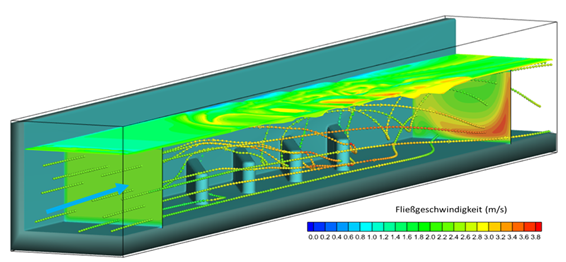
Figure 2: 3D hydrodynamic simulation of the complex flow field in the vicinity of a group of submerged groynes.